Body Contouring
at TEO
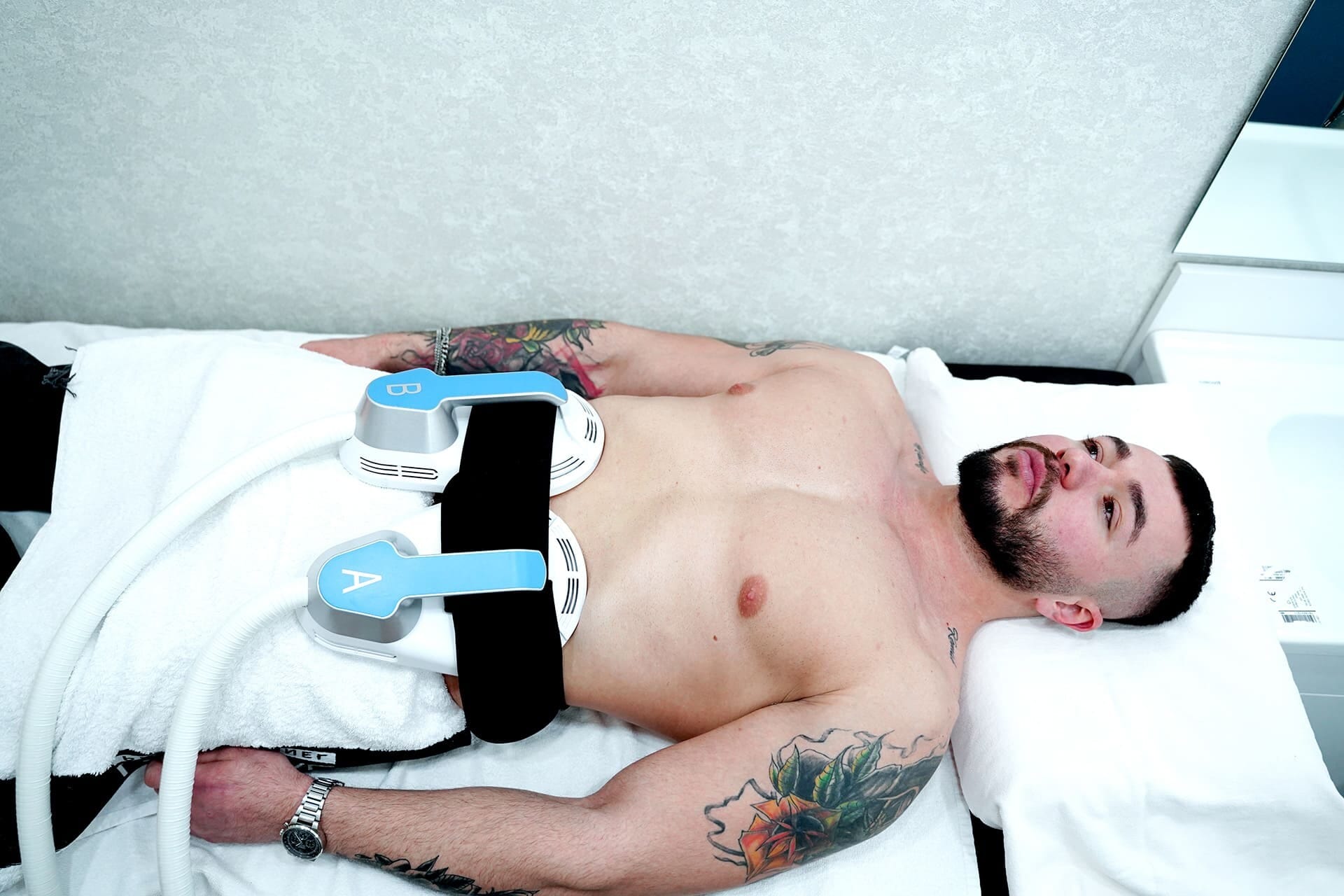
Body contouring is the umbrella term for cosmetic treatments that target the circumference and appearance of one area of the body rather than overall weight. It is used on the areas that respond most slowly to diet and exercise — the abdomen, hips, thighs and arms. At TEO Beauty Centre the programme is built on measurement rather than guesswork: the target area is measured at the start, the plan is set accordingly, and progress is tracked by measuring the same points again.
Why Body Contouring?
One Area at a Time
It targets the area you name rather than the whole body, and what is tracked is that area's circumference — not the number on the scale.
Tracked by Measurement
Starting measurements are recorded and repeated at the same points. Progress rests on numbers, not impressions.
Non-Surgical
No incisions, no stitches, no recovery period. You go back to your day straight after the session.
Planned Individually
The target area, your body type and any health considerations decide which treatment is used and how often.
What body contouring is — and is not
Despite what the name suggests, body contouring is not a weight-loss method. The aim is not to move the number on the scale but to improve the circumference and skin appearance of a specific area. The distinction matters: an expectation set wrongly can make even a programme that is going well look like a failure. Before anything begins we agree on the target area together, measure it, and talk plainly about what is realistic.
The second point: these treatments do not replace nutrition and movement — they work alongside them. The treatment supports circulation and muscle activity in the area, but when daily habits stay the same, holding on to the result becomes difficult. That is why we present the programme not as a solution but as a layer added on top of the routine you keep. We would rather say this at the start than disappoint you later.
Third, body contouring is not a medical treatment. It cannot stand in for the treatment of obesity, a hormonal disorder, lymphoedema or any other health condition. Where one of those is present, the right address is a doctor — and in that case we plan the treatment only with your doctor's knowledge.
"The target is the circumference of that area, not the number on the scale — and the two are not the same thing."
Getting the most out of the programme
Do This
- Have the target area measured before the first session so there is a baseline to compare against.
- Increase your water intake on session days and afterwards.
- Keep the programme alongside regular walking or light exercise.
- Tell the practitioner about medication you take, surgery you have had and any implants.
- Stick to the planned intervals; long gaps break the tracking.
Don't Expect This
- Don't expect a visible change from a single session — these treatments work as a series.
- Don't expect the scale to move; what is measured is circumference.
- Don't expect a lasting result without a change in eating habits.
- Don't expect a whole-body effect; the treatment targets only the area worked on.
- Don't expect the same outcome as a surgical procedure; these operate at a different scale.
Who it is not suitable for
Although body contouring treatments are safe for most people, there are conditions under which they are not applied, or applied only with medical approval. Pregnancy and breastfeeding, a pacemaker or any other electronic implant, a metal implant in the treatment area, an active skin infection, open wounds or eczema, uncontrolled blood pressure and heart conditions, epilepsy, kidney or liver failure, and an active course of cancer treatment head that list.
This is why we run a short health assessment at your first appointment and ask about your medication and past operations. If one of the conditions above applies to you we do not refuse the treatment — we ask for your doctor's approval. This is not a formality: the safety of the treatment rests entirely on the accuracy of that information.
Brands We Use
Body Contouring FAQ
Does body contouring make you lose weight?
No. The aim is not to lower the number on the scale but to improve the circumference and appearance of the targeted area. If weight loss is your goal, that is a matter of nutrition and movement; contouring does not replace it, it works alongside it.
How many sessions are needed?
It varies by person and by target area, and quoting a number in advance would not be honest. At the first consultation the area is measured, your expectation is discussed, and the number and spacing of sessions are planned from there.
How often is it done?
Contouring treatments are usually planned as a series of two or three sessions per week. The exact interval depends on the treatment type chosen and on the initial assessment.
Is it painful?
It varies by treatment type but is generally not painful. Treatments involving electrical stimulation produce a tingling and a muscle-contraction sensation; the intensity is set to your comfort.
Is the result permanent?
Holding on to the difference in measurement depends on keeping up your nutrition and activity. If old habits return after the programme, the area gradually moves back toward where it started.
Can I go back to my day after a session?
Yes. Because it is not a surgical procedure there is no recovery period; you can carry on with your day immediately afterwards.
Body Contouring — book your appointment
Ready to meet our expert team at our Mall of İstanbul studio?
Other Services

Waxing
Hygienic, fast, mark-free hair removal →

Aromatherapy Massage
Balancing body and mind through essential oils →

Permanent Eyeliner
A defined line that empowers your gaze from the moment you wake →

Hydrafacial
Clinical-grade medical skincare with zero downtime →

Silk Lash Extensions
Individually applied lash extensions, indistinguishable from your own →

Keratin Treatment
Formaldehyde-free smoothing keratin and repair protocol →

Laser Hair Removal
Permanent hair reduction with Alexandrite + Diode combination →

Microblading
3D hair-stroke brow tattoo for a natural, dense look →

Ombré
Root-to-tip gradient colour that's easy to maintain →

Organic Hair Colour
Ammonia-free, PPD-free plant-based colour for sensitive scalps →

Perm
Modern cold perm for 4–6 months of natural waves →

Highlights
Foil highlights for crisp, dimensional lift →